I want to put something on the table right now before I say anything else. I don't think having fewer choices is ever a good thing. Multiple ways to do something, multiple places to buy something, multiple formats to own something, that is always more consumer friendly. Full stop. So let me be clear: I am not supporting the push to go all-digital.
But I also have to be honest. I've basically completely converted. I buy almost everything digitally now. And I do believe the numbers, when the market has gone from 85% physical in 2015 to 90-95% digital today, you can't pretend that isn't real. This was always going to happen. The question was never if. It was when.
And on July 1, 2026, the roadmap got put on paper. But before you make this a Sony story, let's slow down. Because this isn't one.
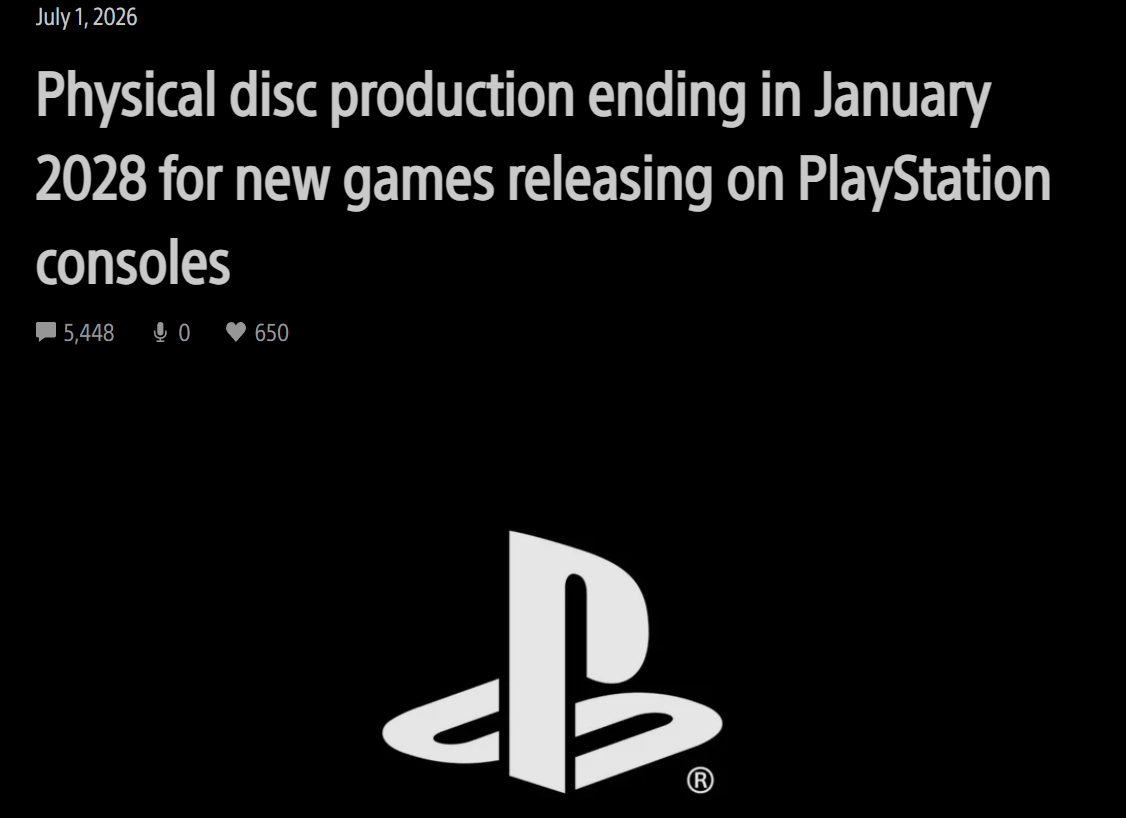
Sony's plan: physical disc production ends January 2028. The PS3 and Vita stores start closing this year in select markets, with a global shutdown following in July 2027.
Xbox's plan: Project Helix, their next console, is reportedly going disc-free. A Disc2Digital program is reportedly in development to convert physical libraries into digital licenses. Not officially confirmed, but the direction is not subtle.
Nintendo's plan: already in motion. The Switch 2 launched with Game-Key Cards, physical cards that contain no game data, just a key to download the game from the internet. They did it quietly. The backlash was smaller. But the move was the same.
And then there's GTA 6. The biggest game in history, demanding $80 for a code in a box. No disc. Rockstar made that call before Sony's announcement even dropped.
The date was always coming. Now we know it. And now we know it's not one company's decision. It's everybody's. Sony just sent the formal announcement. Everyone else was already moving. Keep that in mind for everything that follows.
There's a segment of the PC gaming community that has been very loud about this, and honestly, they have a point. They've been living in a digital-only world for years. They know what gets lost. They've watched games get delisted, licenses expire, and storefronts close. In some ways they're the most qualified people in the room to talk about what this actually means long term because they're not speculating. They already know.
And they also have something console players are about to lose that doesn't get mentioned enough: options. PC isn't just Steam. There's GOG, Epic, itch.io, Humble, direct developer purchases. The ecosystem is open in a way that console never has been. You can move files. You can back things up. You can buy the same game from multiple places. That's a fundamentally different situation than being locked into one storefront on a closed platform where the manufacturer sets every rule.
So when PC players say this is bad, they're right. When they say they've been dealing with it, they're also right. The difference is the safety net. PC has one. Console doesn't.
The irony worth pointing out is that the goodwill Steam has built is earned, not structural. There's nothing that prevents Valve from changing course. They're privately held, they've made good decisions, and there's no precedent that says it stays that way forever. The thing that protects PC players more than anything is competition between storefronts. That's the thing console is about to lose. All of it.
The argument against going all-digital isn't just one thing. It's several things, and each of them deserves its own space.
Ownership. When you buy a digital game you're licensing access to it, not owning it. Sony already pulled over 500 purchased movies from customer accounts due to licensing changes. No refunds. Just gone. Games are next if the economics demand it. Many digital-only 3DS games are already impossible to play legally. That's not a hypothetical. That's what happens when the company holding your license decides the math no longer works.
Preservation. Once the disc goes away, the only copy of a game that exists is the one on a server that a corporation controls and can shut down. Physical media has been the last line of defense against games disappearing from history. Without it, the entire archive of what gaming was and is becomes contingent on whether a company decides to keep the lights on.
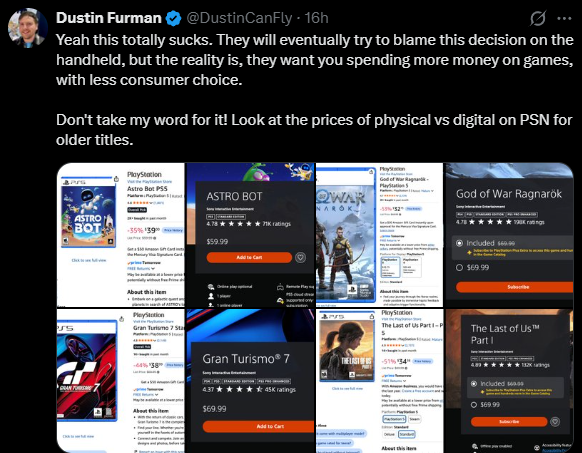
Price competition. Right now you can buy Astro Bot for 35% less on Amazon than on PSN. God of War Ragnarok is 52% cheaper physical. Gran Turismo 7 is 48% cheaper. Those discounts exist because market competition exists. When physical goes away, the PlayStation Store becomes the only place to buy a new PlayStation game. Sony sets the price. Nobody undercuts it. Every sale, every discount, every used copy, gone.
The secondary market. Buying a game for $15 at GameStop when you can't afford $70, gone. Lending a game to a friend, gone. Trading in something you finished to fund something new, gone. These aren't collector concerns. These are how regular people have always made gaming work for them.
I wasn't even thinking about the storage angle until I saw Paul Tassi bring it up: we're being told to go all-digital at the exact moment storage costs are going up. Xbox just cut its 2TB model because it costs too much. You can delete and redownload, sure, but that workaround shouldn't be the answer when you're paying $80 a game. Once you see it you can't unsee it.

None of these arguments are the argument. They're all the argument.
The people who get hurt most by this transition are the people who were already working with the least. The underserved get hit hardest, and not because of nostalgia. Because of access. A monopolized storefront where Sony or Microsoft sets the price and nobody can compete is a storefront where gaming becomes more expensive for everyone and more unreachable for the people already on the margins. The ability to borrow a game from a library ends. The ability to buy a game for $15 when you can't afford $70 ends. Those things have real human impact and they deserve to be named specifically.
Even if the majority of people aren't meaningfully disrupted by this, and I do think most people won't be, a small percentage of a very large number of people is still a lot of people. And they deserve more than a door slammed in their face.
The store closures bother me separately from the disc announcement, and in some ways more directly. Those are games that in many cases only exist on those platforms. Once the store closes they start disappearing and there's no coming back from that.
I understand the server costs argument. I also understand the security argument more than most people in this conversation are giving it credit for. Earlier this year, a vulnerability was discovered in the physical PS4 release of Star Wars Racer Revenge, an obscure Limited Run release of only 8,500 copies worldwide, that exposed a jailbreak entry point directly into the PS5. The vulnerability lives inside Sony's backward compatibility layer, in legacy code that's been carrying security assumptions from 2002 forward across console generations. Pulling the game from digital storefronts doesn't fix it. Firmware patches may not either because parts of this are baked into hardware that's already been sold. Legacy security vulnerabilities in old network infrastructure are a real and complicated problem, and that reality is part of what's accelerating some of these closure decisions. That doesn't make the store closures feel good. But it makes them more understandable than simply "they don't want to maintain it anymore."
What I don't accept is the absence of a thorough plan. Give people real time to migrate what they can. Make sure things going offline have been genuinely thought through. I have games I bought on PS3 that I can only access on a PS3, and now that store is closing. That's not a hypothetical loss. That's mine.
Here's the honest truth that most people in this conversation are dancing around: we all knew this was coming.
This has been the conversation since the PS3 and Xbox 360 generation. People thought the PS4 and Xbox One would be basically disc-free. They weren't. Physical held on longer than anyone expected. But the endpoint was never really in question. We were just negotiating how long we had left.
The future is discless. It always was. The reason this week feels different is not because the destination changed. It's because we arrived. And arrival makes people actually reckon with what they'd been treating as a distant hypothetical.
I truly believe most people won't be meaningfully disrupted by this. But even if it only disrupts a smaller percentage, the collectors, the low-income buyers, the people in areas with unreliable internet, the people who relied on libraries, the people with libraries of games they paid for and can no longer access, that matters. Those people deserve off-ramps, real ones, not a countdown clock and a shrug.
Convert libraries. Make transitions real. Make the lead time mean something. Make sure everything is accessible before stores go dark. Be thorough. Be accountable.
Things have a way of evolving. New marketplaces emerge. New consumer protections get written. I'm not banking on any of it resolving cleanly. I'm not telling you to be patient and trust the process. But the history of technology tells me the transition period is always the hardest part, and what comes out the other side doesn't always look like what we feared going in.
This conversation keeps getting turned into ammunition in a fight nobody should be having. Sony fans vs Xbox fans. Console vs PC. Physical loyalists vs digital converts. None of that is the point and all of it is a distraction.
Nobody gets a pass. Sony put out the press release so they're absorbing the reaction, but Nintendo is already doing this. Xbox is heading the same direction. GTA 6 is rolling out without a disc. This is everyone.
The disc is dead. That's real. But what we do with that reality, how loud we are, how specific we get about what we need, how much we demand that the people losing the most get taken care of first, that part isn't decided yet.
We have to push these companies to give us options. Real ones. Ways to maintain ownership, ways to keep choice alive, ways to make sure what you paid for actually stays yours. Stop Killing Games is the most organized push in that direction right now and it's worth your attention. Be loud. Be specific. That's how this gets better.